
Reviewed · BELGRADE TOURS
Underground Secrets of Belgrade
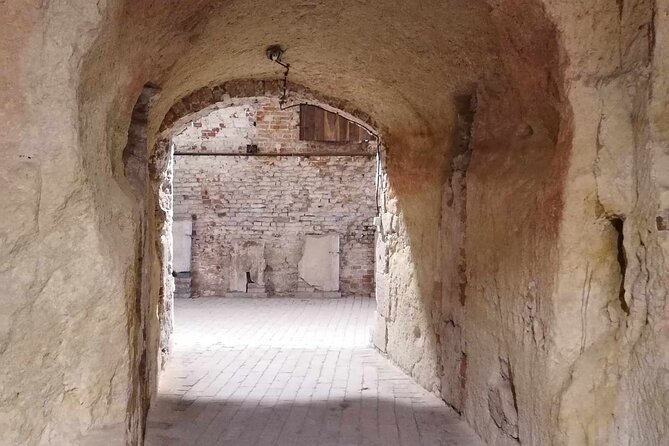
Belgrade keeps some of its best stories below street level. This tour takes you from the fortress’s 51-meter Roman Well to a Cold War bunker, then into old gunpowder and food-storage caverns before ending with wine in a 19th-century cellar. I like the mix of Roman, Austrian, military, and everyday commercial history, all packed into about two and a half hours.
I also like that the tour includes admission fees and a glass of wine, so the $24.06 price covers more than a simple walk around town. Guides such as Michael and Stefan have been praised for making the fortress stories lively and clear. The main caution is practical: steep, narrow stairs, uneven ground, and limited handrails make this a poor fit for anyone with mobility problems.
Key points at a glance
- The Roman Well reaches 51 meters below the Belgrade Fortress, with two spiral staircases meeting partway down in a striking DNA-like design.
- A Cold War bunker shows a less romantic side of Belgrade, built for military use but never used for its original purpose.
- Barutana is a man-made cave and former Austrian gunpowder storehouse, with Roman and Byzantine stonework displayed in its Lapidarium.
- The final stop combines old storage caverns and wine, ending at a cellar on Karađorđeva Street with a free glass included.
- The English-speaking group is capped at 20 people, but one guide may be easier to hear than another in echoing underground rooms.
- Wear sturdy shoes and expect difficult steps, especially at the Roman Well and other underground sites.
Why Belgrade’s underground deserves a closer look

Belgrade’s fortress is easy to treat as a scenic overlook and a pleasant place for a walk. This experience changes the focus. Instead of staying on the walls and viewpoints, you go below them, where the city’s military past becomes physical: narrow stairs, cool stone, old storage rooms, and spaces built for war or survival.
I like this approach because the stops are not all from the same period. The Roman Well belongs to the fortress’s baroque reconstruction in the early 18th century. Barutana reaches back to the 16th century and Austrian military planning. The bunker brings you into the 1950s and the Cold War. The final cellar shifts away from military history and shows how underground rooms were used for food and wine.
That range gives you a useful short course in Belgrade’s past. You are not simply looking at ruins. You are seeing how people used the same strategic hill and riverside area for defense, storage, shelter, and trade.
The tour lasts about two hours and thirty minutes. It begins at Republic Square, a central meeting point, and finishes at Vinarija on Karađorđeva 31, close to Branko’s Bridge. That one-way route is helpful because you do not have to return to the starting point after the wine stop.
A few more Belgrade half-days to weigh up
- Northern Serbia: Sremski Karlovci and Novi Sad Full-Day Tour from Belgrade
★ 5.0 · 425 reviews - Day Trip from Belgrade: Gems of Eastern Serbia
★ 5.0 · 424 reviews - Belgrade Nightlife Bar Pub Club Crawl with Drinks
★ 5.0 · 277 reviews
The Roman Well and Belgrade Fortress

The fortress stop takes about an hour and carries the most historical weight. The Roman Well is the star. Despite its name, the structure dates to the beginning of the 18th century, when the fortress was being rebuilt in the baroque style. Its name and legends give it an air of mystery, but the dimensions are what make it memorable.
The well is about 51 meters deep and 3 meters across. Two spiral staircases descend into it and connect at roughly 35 meters below ground. Seen from above, the stair design resembles a DNA strand. That unusual layout is more interesting than a standard staircase because it shows how the builders used a tight vertical shaft while allowing movement in two directions.
You should expect a confined space and a strong sense of height. The stairs are narrow and steep, and the setting is not designed like a modern museum. This is one of the places where good shoes, steady footing, and a willingness to move slowly matter more than fitness or speed.
The guide adds the human detail. Alfred Hitchcock visited the well in 1964 and reportedly appreciated its atmosphere. That story fits the place: it has the kind of severe, enclosed setting that feels made for a suspense film. Still, the value is not only in the spooky mood. The well helps you understand how fortresses depended on access to water, especially during a siege.
A guide can also help connect the well to the wider fortress. Michael has been praised for providing a steady stream of historical detail and for clearly enjoying the subject. Stefan has also received strong marks for explaining Belgrade in a clear, useful way. The quality of this part depends heavily on the guide’s English and delivery, since the stone surfaces can make speech hard to follow.
After the well, the group enters a military bunker from the mid-1950s. This changes the mood from old fortress engineering to Cold War planning. The bunker was built for a military purpose but never used for that original role. That fact gives the stop a slightly unfinished feel, as if you are looking at a plan for a crisis that never arrived.
The bunker is valuable because it widens your view of Belgrade’s underground spaces. You are not only seeing medieval or imperial remains. You are also seeing how the city prepared for modern threats, when concrete, secrecy, and shelter mattered more than grand walls.
Barutana, the old gunpowder storehouse
The second stop lasts about 30 minutes and takes you to Barutana. This man-made cave served as an Austrian gunpowder storehouse and dates to the 16th century. The name is closely tied to its military use, but the stop offers more than a bare room cut into rock.
Inside the display area known as the Lapidarium, you can see Byzantine and Roman sarcophagi, gravestones, and statues. These pieces add an archaeological layer to the tour. You are looking at stone objects connected to earlier eras, now displayed inside a later military space.
That combination is one of the best features of the experience. Belgrade has changed hands and purposes many times, and Barutana makes that visible without requiring a long museum visit. The underground room becomes a setting where older remains and later military construction sit side by side.
The stop is shorter than the fortress visit, which is sensible. There is enough to see without making the tour feel like a long archaeological lecture. The guide’s explanation matters here because a sarcophagus or fragment of a gravestone can look like just another block of stone without context.
Do not expect a large museum collection or polished exhibition hall. Barutana is about atmosphere and place. The cave itself is part of the story, and the display room gives you a reason to look closely at the stonework. If you prefer grand monuments and open views, this will feel modest. If you like seeing how objects survive and get reused across centuries, it earns its place on the route.
Karađorđeva’s food caverns and wine cellar
The final visit lasts around 45 minutes and shifts from fortification to storage. In the caverns on Karađorđeva, food was kept underground, making practical use of stable, enclosed space. You then visit a wine cellar from the 19th century before finishing with a free glass of wine.
I like this part because it brings the history down to an everyday level. Fortresses and bunkers can make the past feel like a story about rulers and armies. Food storage and wine show the ordinary systems that kept a city supplied and helped businesses operate.
The wine is included, not an extra purchase. It is a modest perk, but it improves the ending and gives the group a natural pause after the underground rooms. The tour finishes at Vinarija, at Karađorđeva 31, near Branko’s Bridge. You can continue your evening from there instead of retracing the route to Republic Square.
The stop is also useful for anyone interested in Belgrade’s food and drink traditions, but the provided details do not specify the wine selection or whether additional tastings are available. Treat the free glass as part of the tour rather than planning the whole evening around a formal wine tasting.
A completely different kind of day out:
- Taxi to/from Belgrade Airport to/from Belgrade City Center
★ 5.0 · 241 reviews - Belgrade Big Tour: Top Attractions and Belgrade Neighborhoods
★ 5.0 · 232 reviews - Along the Danube: Golubac Fortress & Iron Gate Gorge day trip from Belgrade
★ 4.5 · 185 reviews - From Belgrade: Golubac Fortress & Iron Gate Danube Gorge
★ 4.8 · 185 reviews
How the guiding affects the experience

This is a guide-led experience, and the guide makes a real difference. Michael has been praised for delivering a large amount of fortress history with clear enthusiasm. Stefan has been described as a strong source of general information about Belgrade. Milan has received credit for handling the underground sights well, though one useful criticism was that the walk between stops could include more explanation of the surrounding area.
That last point is worth noting. The tour’s main subject is underground Belgrade, so the guide may focus most of the commentary once you reach each site. If you want a continuous city walk with stories about every street between stops, this may feel less satisfying. If you mainly want access to the underground locations, the walking sections are simply the links between them.
English ability can vary. One visitor had difficulty understanding much of the commentary because the guide’s English was very basic. In enclosed rooms, sound can also become a problem. A separate report described a group without audio equipment, making it hard to hear even though the guide was trying his best.
I would stay near the guide, especially in the bunker and Barutana. If you are in a group of up to 20 people, standing at the back can make a real difference. The maximum size is reasonable for an underground walk, but it is not the same as a private tour.
Is the $24.06 price good value?

At $24.06 per person, the tour is priced fairly for a two-and-a-half-hour guided experience that includes entrance fees and a glass of wine. You are paying for access to several places that are not simply open public rooms, plus the guide’s explanation of how they fit together.
The value is strongest if you have a limited amount of time in Belgrade and want a focused historical activity. The tour covers four distinct underground settings: the Roman Well, the Cold War bunker, Barutana, and the food-storage and wine-cellar spaces. You would not need to arrange separate visits or figure out how to connect them yourself.
The value is weaker if you dislike confined spaces, stairs, or history presented mainly through spoken explanation. This is not a polished attraction with broad walkways and extensive signs. Much of the experience depends on listening, moving carefully, and accepting that some rooms are rough around the edges.
Group discounts are available, and the group limit is 20. Since the price is already moderate, a discount could make this a sensible choice for families or small groups, though the tour’s physical demands still apply.
Who should book, and who should skip it?
I would recommend this tour to first-time visitors who want a different side of Belgrade than the usual central squares and fortress viewpoints. It suits people who enjoy military history, old engineering, archaeology, and unusual city spaces. The route also works well for anyone who likes a clear beginning and end, since it starts in the center and finishes near Branko’s Bridge.
You should be comfortable with narrow stairs and uneven ground. The late-70s couple who found the tour very difficult pointed to steep steps, no handrails in places, and rough surfaces. The published details say most people can participate, but that should not be read as a promise of easy access. If you have balance concerns, serious knee problems, or difficulty with stairs, ask the provider for current conditions before booking.
The tour is offered in English. Because the underground rooms can echo and there may be no audio system, listeners should stay close to the guide. If detailed spoken history is the main reason you are booking, consider the guide’s communication style as important as the route itself.
Practical details before you go
The meeting point is Republic Square, at Trg republike 3. The tour ends at Vinarija, Karađorđeva 31, close to Branko’s Bridge. Both points are near public transportation, and the one-way finish can be convenient for planning dinner or an evening walk.
Wear shoes with good grip. The Roman Well includes steep, narrow stairs, and the other underground sites have uneven surfaces. Comfortable clothing is sensible, but the key issue is footwear and confidence on steps.
Confirmation is provided when you book. Free cancellation is available if you cancel at least 24 hours before the start time. Cancellations or changes made less than 24 hours in advance are not refunded or accepted, and the cut-off follows local time.
The tour is capped at 20 people. That is small enough to keep the group manageable, but you should still position yourself where you can hear. Keep personal spending separate from the tour price, since personal expenses are not included.
My final call on Underground Secrets of Belgrade

Book it if you want a compact, unusual history tour with real underground access, a strong fortress focus, and a pleasant wine finish. The Roman Well is the main reason to go, while Barutana and the bunker give the experience more range than a single-site visit.
Skip it if you need step-free access, quiet one-on-one guiding, or a polished museum setting. The physical conditions are the biggest concern, and the quality of the English explanation can vary by guide.
For the right visitor, $24.06 is a good deal: several paid sites, a professional guide, and a free glass of wine in one route. Just arrive ready for tight spaces, stay close enough to hear, and think of this as an atmospheric underground walk rather than an easy sightseeing stroll.
FAQ
How long does Underground Secrets of Belgrade last?
The tour lasts approximately two hours and thirty minutes.
Where does the tour begin?
It begins at Republic Square, Trg republike 3, in Belgrade.
Where does the tour end?
The tour ends at Vinarija, Karađorđeva 31, near Branko’s Bridge.
What is included in the tour price?
The price includes entrance fees, a professional tour guide, and a free glass of wine at the final stop.
Is the tour offered in English?
Yes. The experience is offered in English.
Can I cancel for a full refund?
Yes, provided you cancel at least 24 hours before the experience start time. Cancellations or changes made less than 24 hours in advance are not accepted for a refund.
Just added around Belgrade
- Private Half Day Serbia Tour Novi Sad and Petrovaradin Fortress★ 5.0 · 3 reviews
- 3-Hour Belgrade Zemun Neighborhood Tour★ 5.0 · 8 reviews
- Private Belgrade Street Art and Adventures Walking Tour★ 5.0 · 4 reviews
- Urban & Alternative Belgrade tour★ 5.0 · 4 reviews
- Belgrade Bike Tour: Be a local in the hood of Belgrade!★ 5.0 · 5 reviews
- From Belgrade:Uvac Nature Reserve Tour★ 5.0 · 4 reviews
- Private Wine Tasting by Party in Belgrade★ 5.0 · 3 reviews
- Shooting Experience by Party in Belgrade★ 5.0 · 8 reviews
Belgrade Tours, compared.
Sremski Karlovci and Novi Sad Full-Day Tour from Belgrade
Read our review →
Day Trip from Belgrade: Gems of Eastern Serbia
Read our review →
Belgrade Nightlife Bar Pub Club Crawl with Drinks
Read our review →
Belgrade Big Tour: Top Attractions and Belgrade Neighborhoods
Read our review →
Belgrade Underground Tour w/ Sparkling Wine Along the River
Read our review →
Iron Gate NP Tour with 1-hour speedboat ride + 2 viewpoints
Read our review →Browse the lists this tour appears in