
Reviewed · PRIVATE
Private 4 Hours Space Architecture Tour in Belgrade
Belgrade’s architecture tells the story of a country that tried to build a new society in concrete, glass, steel, and enormous public spaces. This private tour takes you far beyond the usual center, from the rebuilt Avala Tower to the hard-to-reach socialist landmarks of New Belgrade.
I like two things right away. First, you get a private vehicle and door-to-door pickup, which makes it possible to see scattered sites in four hours. Second, the guides do more than identify architectural styles. Guides such as Stefan, Novica, Nemanja, Mihailo, and Milos explain how Serbian and Yugoslav politics shaped the buildings you are seeing.
The main consideration is pace. Four hours includes substantial driving, so most stops are brief, usually 15 to 20 minutes. If you want long photo sessions or interior visits, this will feel more like a focused city overview than a slow architectural study.
Key points to know before booking
- Avala Tower reaches beyond the city center: Ride to Belgrade’s tallest mountain for views from a rebuilt telecommunications tower.
- The tour links distant landmarks efficiently: A private, air-conditioned vehicle covers sites that are awkward to connect by public transport.
- Brutalism is only part of the subject: You’ll also discuss Yugoslav socialism, national identity, state power, and postwar reconstruction.
- The group stays private: The price is $175.14 for up to three people, with pickup and drop-off at your accommodation.
- The guides add real historical context: Stefan, Novica, Nemanja, Mihailo, Mikhail, and Milos have been praised for clear explanations and lively storytelling.
- Expect short stops: The schedule includes drive time, so the value comes from seeing a lot of Belgrade in one compact outing.
Why this four-hour route works
This is not a walking tour with a few modern buildings added at the end. It is a driving route through several parts of Belgrade, including Avala south of the city, New Belgrade, and the Sava River corridor.
That matters because the buildings are widely separated. You could visit some on your own, but reaching all six stops would take planning, transfers, and a good sense of the city. The private format also lets you ask questions as the route unfolds. If one building catches your attention, you can use the drive between stops to discuss it rather than waiting for a large group to move along.
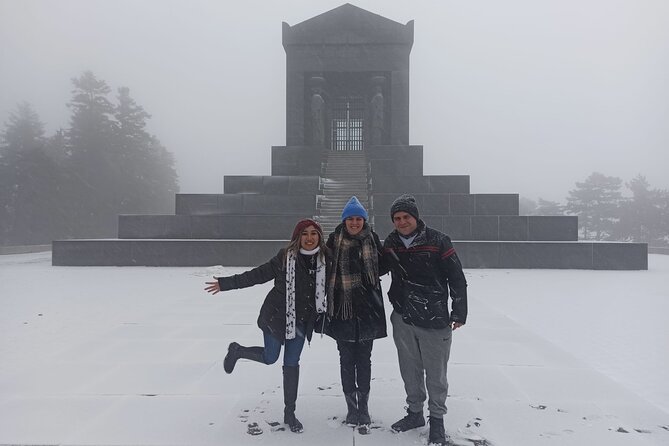
Pickup is offered from your accommodation, and the same vehicle returns you there at the end. The vehicle is air-conditioned, a useful detail during warmer months, though the tour also operates in colder weather. One outing reached Avala Tower with snow on the ground, so poor weather does not automatically end the plan.
The price is $175.14 per group of up to three. For three people, that works out to $58.38 each for four hours, including transport, guide service, and entrance fees. For one person, it is a much more expensive private outing. For a couple or small family, though, the cost is easier to justify because you are paying for a dedicated vehicle and guide rather than separate public transport and admission costs.
A few more Belgrade half-days to weigh up
- Northern Serbia: Sremski Karlovci and Novi Sad Full-Day Tour from Belgrade
★ 5.0 · 425 reviews - Day Trip from Belgrade: Gems of Eastern Serbia
★ 5.0 · 424 reviews - Belgrade Nightlife Bar Pub Club Crawl with Drinks
★ 5.0 · 277 reviews
Avala Tower and the view from the city’s tallest mountain
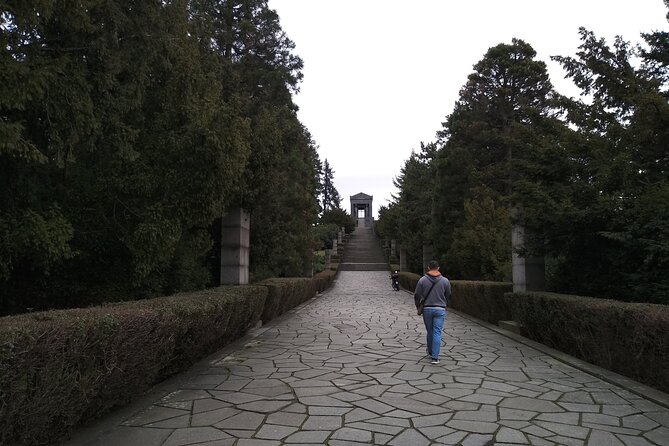
The first stop is Avala Tower, roughly 30 to 45 minutes from central Belgrade. The journey takes a noticeable part of the tour, but it also gives your guide time to introduce the wider story of Serbia and Yugoslavia before you begin the city portion.
The tower was destroyed during the 1999 NATO bombing and rebuilt in 2010. That fact gives the structure an unusual role. It is both a piece of telecommunications infrastructure and a symbol of loss, reconstruction, and national memory.
You have about 45 minutes here, with admission included. The observation deck offers a broad view toward Belgrade and the surrounding area. On a clear day, this is the one stop where the city’s scale becomes easiest to understand. You can see why the later sites were placed where they are, especially the broad New Belgrade district and the major river crossings.
This stop is also a practical reason to book a vehicle. Avala is outside the central sightseeing zone, and the tour removes the need to arrange a separate trip. Bring a jacket if the forecast is cool. The exposed mountain setting can feel different from the city below.
The Eastern City Gate and Yugoslav high-rise living
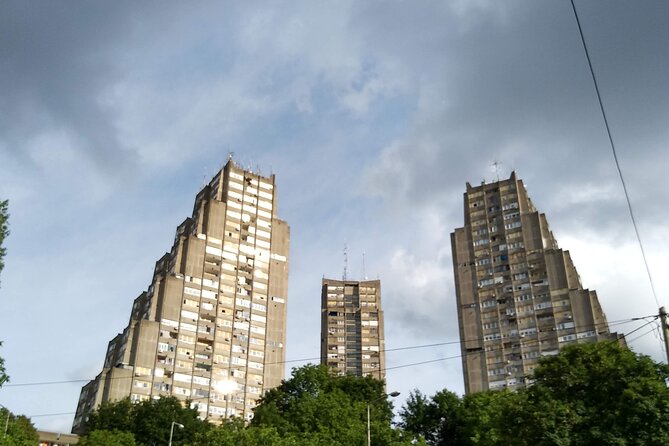
After another 30 to 45 minutes on the road, you reach the Eastern City Gate, officially called Rudo. It is a complex of three residential towers, each rising about 85 meters, built in the brutalist style.
You have 20 minutes here. That is enough to take in the arrangement of the towers and hear why they became one of Belgrade’s symbols. The buildings are not isolated monuments. They are working residential blocks, which helps you see brutalism as part of everyday urban life rather than only as a style used for government buildings.
The Eastern City Gate reflects the ambition of Yugoslav socialism: large housing projects, strong geometric forms, and architecture designed to express a modern collective future. Your guide can connect the appearance of the buildings with the social and political ideas behind them.
This is not an interior tour. The stop focuses on the exterior, and the brief timing means you should arrive ready to look, photograph, and listen. If you are especially interested in residential architecture, tell your guide early. The private format makes that kind of question easier to pursue.
Ada Bridge above the Sava River
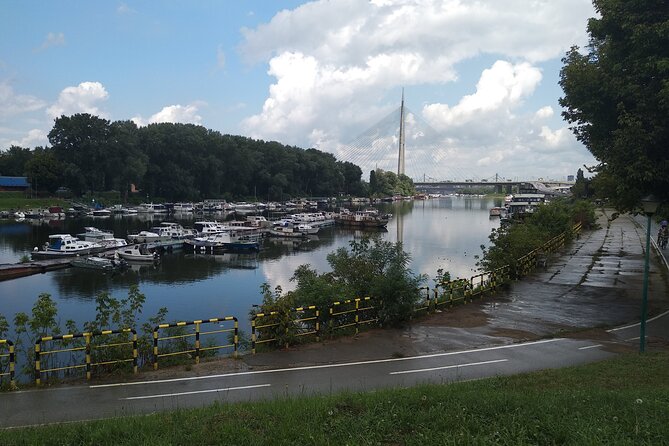
From the Eastern City Gate, the drive to Ada Bridge takes about 10 to 15 minutes. You cross the Sava River on one of Belgrade’s most recognizable pieces of recent infrastructure.
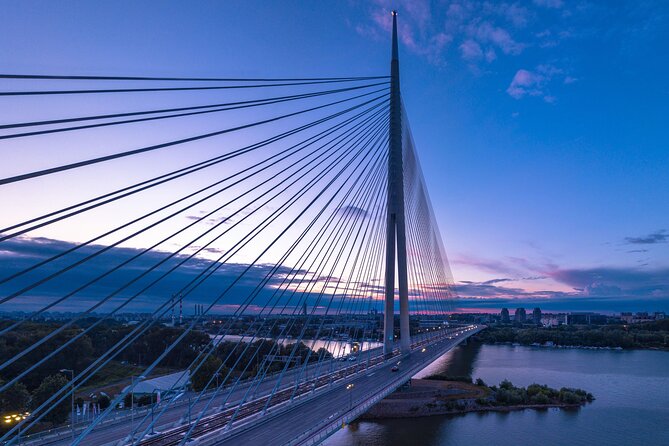
The bridge is a cable-stayed design with a single pylon, and its construction was featured on the Discovery Channel. The tour description presents it as the highest single-pylon bridge in Europe, making the structure worth seeing even if your main interest is older socialist architecture.
You have about 20 minutes at this part of the route. The stop gives you a change of scale. At the Eastern City Gate, you are looking up at residential towers. Here, you are considering how a major bridge organizes movement across the river and shapes the city’s modern identity.
The bridge is best understood as part of Belgrade’s continuing development. The tour does not treat the city as a museum frozen in the Yugoslav period. Instead, it places older state projects beside newer engineering work, showing how Belgrade keeps adding to its visual story.
A completely different kind of day out:
- Taxi to/from Belgrade Airport to/from Belgrade City Center
★ 5.0 · 241 reviews - Belgrade Big Tour: Top Attractions and Belgrade Neighborhoods
★ 5.0 · 232 reviews - Along the Danube: Golubac Fortress & Iron Gate Gorge day trip from Belgrade
★ 4.5 · 185 reviews - From Belgrade: Golubac Fortress & Iron Gate Danube Gorge
★ 4.8 · 185 reviews
Sava Center and the architecture of international diplomacy
The Sava Center is only about 10 minutes from Ada Bridge. You have 15 minutes to examine its angular, polyhedral forms.
The complex was built for the 1977 Conference on European Security and Cooperation in Belgrade. At the time, it was the first and largest conference center in former Yugoslavia. That background changes how you read the building. It was not simply a large event venue. It was designed to present Belgrade as a place where international diplomacy could happen.
Look for the relationship between the building’s many planes and its overall size. The structure can feel imposing, but the geometric design keeps it from becoming a plain block. Your guide can explain how the building’s shape served both practical needs and the image of a confident, outward-looking state.
The stop is short, so do not expect a full building visit. The value is in seeing the exterior while learning why it was commissioned and what role it played in Yugoslavia’s international position.
Palace of Serbia and architecture as political language
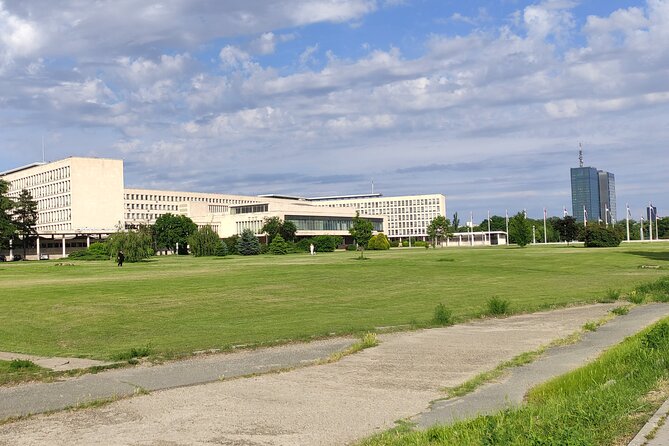
A five-minute drive takes you to the Palace of Serbia, formerly the Federal Executive Council. You spend about 15 minutes outside this enormous late-modernist building.
This is one of the clearest examples on the route of architecture used to express government. The scale is grand, but the description of the building as elegant is useful. It is not just a heavy block meant to intimidate. Its design tries to combine authority, ceremony, and modern administration.
The Palace was the first major New Belgrade project after the Second World War. That places it at the beginning of a much larger urban experiment. New Belgrade was planned as a new administrative and residential district, separate in character from the older city center.
This is where a strong guide adds the most value. A quick photograph cannot explain why the building was placed here, how it fit the postwar state, or what its design said about power. Guides such as Stefan, who has academic training in history, have been praised for connecting the architecture to Serbian society and Yugoslav politics rather than treating it as a collection of shapes.
Genex Tower, the Western Gate of Belgrade
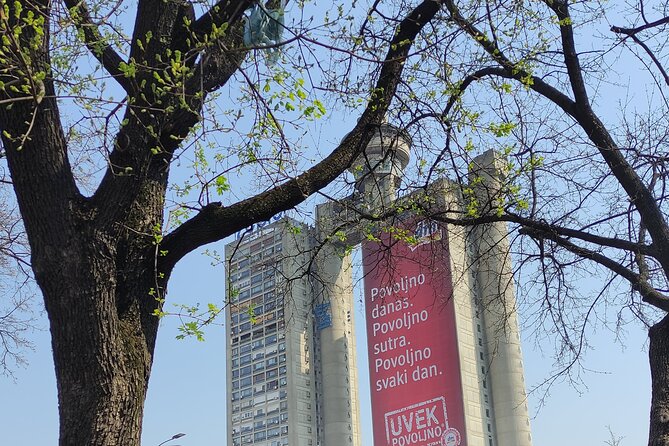
The final stop is the Western City Gate, better known as Genex Tower, around 10 minutes from the Palace of Serbia. You have 15 minutes to see this 36-story complex designed in 1977 by Mihajlo Mitrović.
The form is hard to miss. Two towers are joined by a two-story bridge, creating a gateway effect on the western approach to Belgrade. One tower was associated with commercial use, while the other was residential, although the supplied tour details focus on the building’s overall form and brutalist design rather than promising interior access.
Genex Tower is a fitting final stop because it brings together many of the ideas raised earlier: monumental scale, practical urban planning, concrete construction, and the desire to make a bold statement at the edge of the city. It also shows how a building can become an image of Belgrade even when its original purpose was ordinary work and housing.
The stop is brief, so use your time to study the connection between the towers and the way the structure frames the road. If you want a detailed discussion of the architect or the building’s present condition, ask your guide before you arrive.
What the guide adds to the buildings
The strongest part of this experience is the explanation between stops. Architecture alone can be difficult to read, especially when you are looking at buildings created for a political system that no longer exists.
The guides who have led this route include Stefan, Novica, Nemanja, Mihailo, Mikhail, and Milos. Their backgrounds and styles vary, but the consistent strength is the link between design and history. Stefan has been described as having degrees in history. Novica is particularly good at keeping the story moving while discussing Serbia and Yugoslavia. Nemanja has also shaped custom programs for people interested in socialist architecture and monuments.
You should not assume you will receive a specific guide when booking, but you can expect an English-speaking professional guide. If you have a serious interest in brutalism, Spomeniks, urban planning, or postwar architecture, contact the operator before the tour and explain what you want to discuss. A previous group contacted Belgrade Walking Tours the day before and received a tailored program, so it is worth asking rather than keeping your interests to yourself.
Who will get the most from this tour
I would choose this experience if you have already seen central Belgrade and want to understand the city beyond the pedestrian streets and historic fortress. It also suits architecture students, photographers, urban planners, and anyone curious about Yugoslavia’s socialist past.
It is a good match for a couple or group of three. The private setting lets you ask direct questions and keeps the day more personal than a large coach outing. It is also useful if you have limited time and want to cover distant sites without spending half the day navigating public transport.
I would hesitate if your priority is slow exploration. The schedule allows 45 minutes at Avala Tower but only 15 to 20 minutes at most city buildings. You will see a lot, but you will not linger at every site.
Most people can participate, and service animals are allowed. Pickup and drop-off are provided at your address. Personal expenses are not included, so plan to pay separately for anything outside the stated admissions and transport.
Booking, timing, and cancellation
The tour operates daily from 9:00 a.m. to 5:00 p.m. The listed operating period runs from March 29, 2023, through March 11, 2027. Transportation time is already included in the roughly four-hour duration, so you should not expect four full hours at the buildings.
Confirmation is provided at booking. Free cancellation is available if you cancel at least 24 hours before the local start time. Changes or cancellations inside that window are not accepted for a refund.
Should you book the Space Architecture Tour?
Book it if you want Belgrade explained through its buildings, not just photographed. The combination of Avala Tower, brutalist housing, a major bridge, a diplomatic conference center, a federal palace, and Genex Tower gives you a strong cross-section of the city’s modern identity.
The price makes the most sense for up to three people sharing the private vehicle. You get pickup, drop-off, an air-conditioned car, entrance fees, and an English-speaking guide, while avoiding difficult cross-city connections.
Skip it if you want interiors, long walks, or extensive time at each building. But if you have four hours and a genuine interest in architecture, Yugoslav socialism, and the forces that shaped Belgrade after the Second World War, this is one of the more efficient ways to see the city’s modern side.
FAQ
How long does the private architecture tour last?
The tour lasts approximately four hours, and transportation between sites is included in that total.
How many people can join the private tour?
The price covers one private group of up to three people.
Is pickup from my accommodation included?
Yes. Pickup and drop-off from your accommodation are included.
Which language is the tour offered in?
The tour is offered in English.
Which landmarks are included?
The route includes Avala Tower, the Eastern City Gate, Ada Bridge, Sava Center, the Palace of Serbia, and the Western City Gate, also known as Genex Tower.
Can I cancel for a full refund?
Yes. You can cancel for a full refund if you do so at least 24 hours before the experience’s local start time. Cancellations or changes made less than 24 hours before the start are not refunded.
Just added around Belgrade
- Private Half Day Serbia Tour Novi Sad and Petrovaradin Fortress★ 5.0 · 3 reviews
- 3-Hour Belgrade Zemun Neighborhood Tour★ 5.0 · 8 reviews
- Private Belgrade Street Art and Adventures Walking Tour★ 5.0 · 4 reviews
- Urban & Alternative Belgrade tour★ 5.0 · 4 reviews
- Belgrade Bike Tour: Be a local in the hood of Belgrade!★ 5.0 · 5 reviews
- From Belgrade:Uvac Nature Reserve Tour★ 5.0 · 4 reviews
- Private Wine Tasting by Party in Belgrade★ 5.0 · 3 reviews
- Shooting Experience by Party in Belgrade★ 5.0 · 8 reviews
Private, compared.
Private Red Star-Partizan Stadium Tour in Belgrade
Read our review →
Private transfer from Belgrade or Belgrade Airport to Novi Sad
Read our review →
Private Day Tour to Fruska Gora Monasteries, Sremski Karlovci and Novi Sad
Read our review →
Private Novi Sad, Titanic wine tasting and Farmer’s House
Read our review →
Private Limo Transfer from Beograd Airport to Belgrade downtown
Read our review →Browse the lists this tour appears in