
Reviewed · BELGRADE TOURS
Belgrade: The White Emigration in Serbia in the Wake of the Russian Revolution
Belgrade carries an unusual Russian story. After the Bolshevik Revolution, up to 100,000 Russians arrived in the Kingdom of Serbs, Croats and Slovenes. This walk follows what they built, taught, performed, and left behind, from Baron Wrangel’s grave to royal monuments and old cafés. The White Emigration gives you a fresh way to read the Serbian capital.
I like the route for two clear reasons: it connects big political questions with ordinary city sights, and it brings in culture, food, architecture, and personal stories rather than treating history as a list of dates. Guide Julja is described as especially strong on Serbian history and able to handle detailed questions.
The drawback is the price: $173.64 per person is a serious charge for a three-hour walking tour, especially since drinks and snacks cost extra. The value improves if you are traveling as a private group, want a focused historical guide, and care about this subject. It is less convincing if you simply want a general introduction to Belgrade.
Key points before you book
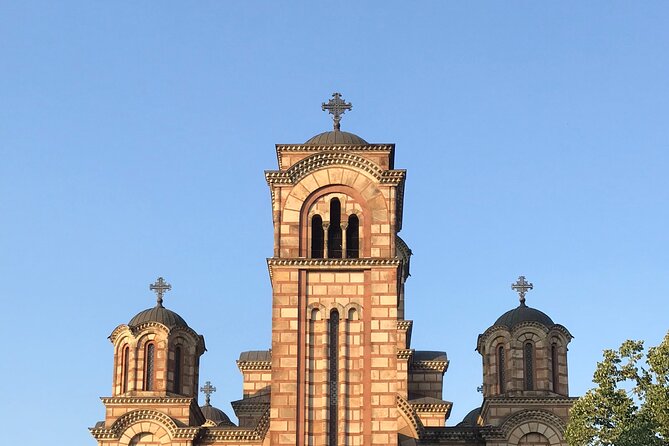
- Follow the Russian White Emigration through seven central Belgrade stops, including Holy Trinity Church, the Royal Palace area, Hotel Moskva, and the National Theatre.
- Meet guide Julja, whose approach combines Serbian history with Russian political, military, artistic, and academic stories.
- Explore the White Army in exile, including the difficult question of how a trained and partly armed army could live abroad without taking power or starving.
- Learn why Nansen passports mattered, a practical answer to statelessness that still has meaning in modern discussions.
- Expect a private walking experience, with only your own group taking part and possible group discounts.
- Budget extra for coffee and cakes, including the Moskva and Aurora cakes at Hotel Moskva.
Why Russian history belongs in a Belgrade walk
The Russian arrival after 1917 was not a small footnote. Between one and two million people left Russia over roughly three years, and as many as 100,000 reached the Kingdom of Serbs, Croats and Slovenes. For a country with a relatively small population, that was a major arrival of skilled, educated, and politically complicated newcomers.
This tour asks you to look for that influence in places you might otherwise pass without a second thought. A church, a ministry building, a theatre, a hotel, and an academic institution become evidence of a community trying to rebuild its life.
I like this approach because it avoids the usual problem with historical walking tours. You are not only shown a plaque and handed a date. You are asked how a government responds when large numbers of refugees arrive, how professionals find work, and how an army survives after losing its country.
The guide also tackles uncomfortable questions. Why did so many Russians settle in Serbia? Why did Serbia agree to host a trained and partly armed foreign army? How could that army avoid overthrowing a government, seizing territory, or collapsing from hunger?
You should not expect a military tour alone. The route also covers Russian architects, dancers, stage workers, scientists, craftsmen, and café culture. That range is one of its best features.
A few more Belgrade half-days to weigh up
- Northern Serbia: Sremski Karlovci and Novi Sad Full-Day Tour from Belgrade
★ 5.0 · 425 reviews - Day Trip from Belgrade: Gems of Eastern Serbia
★ 5.0 · 424 reviews - Belgrade Nightlife Bar Pub Club Crawl with Drinks
★ 5.0 · 277 reviews
Holy Trinity Church and Baron Wrangel
The walk includes a visit to the Russian Holy Trinity Church, where Baron Pyotr Wrangel is buried. Wrangel, often called the Black Baron, was one of the best-known leaders of the anti-Bolshevik forces and a key figure in the White Army’s later years.
This stop gives the tour a strong opening. Instead of beginning with an abstract account of exile, you are placed beside the grave of a person linked directly to the military and political crisis that sent so many Russians abroad.
The church also helps explain that the émigré community was not one simple group. It included soldiers, aristocrats, professionals, artists, and families. Some had money and connections. Others had lost nearly everything. Their shared language and opposition to Bolshevism did not erase their different backgrounds.
Admission to the church is listed as free. Allow about 30 minutes for this part of the route. Since the full experience lasts around three hours, the guide has enough time to explain the setting without turning the stop into a rushed photo break.
Serbian Parliament and the Russian imprint on Belgrade
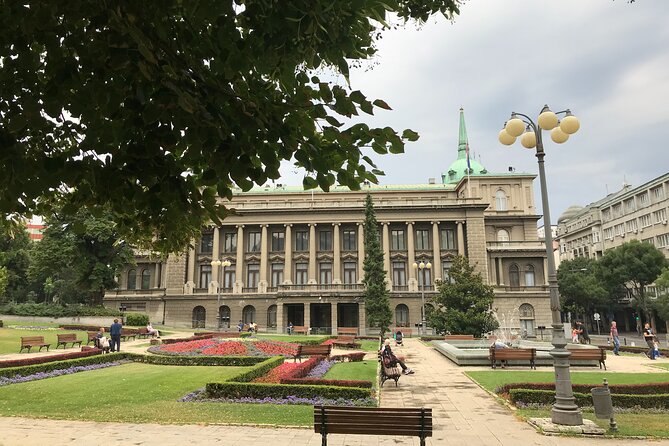
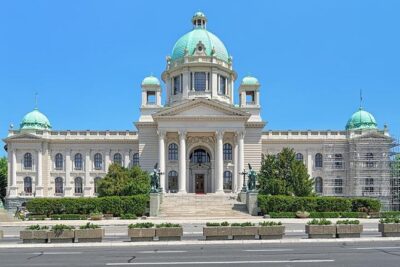
From the church, the walk passes through a picturesque former royal park toward the Serbian Parliament and nearby public buildings, including the post office, General Staff, and ministries.
Here the theme shifts from exile as a political problem to exile as a force in city life. Russian architects contributed to Belgrade’s appearance, and the guide examines why that contribution is not always acknowledged in a simple or direct way.
That is a useful subject for anyone interested in architecture. Buildings often outlast the arguments around them. A visitor may admire a façade without knowing who designed it, what school of architecture shaped it, or how political circumstances brought that person to Serbia.
The tour does not promise interior access to every building, so you should think of this section as an outdoor architectural and historical reading of the city. You will look at public buildings while learning how Russian professionals found a place in Serbian public life.
This stop lasts about 30 minutes. It should suit you if you enjoy connecting a city’s appearance with migration and politics. If you mainly want interiors or formal architectural visits, this section may feel more observational.
Royal connections and the monument to Nicholas II
The route continues past the Royal Palaces and a monument to Nicholas II. This opens a discussion of the relationship between the Serbian and Russian dynasties.
That relationship helps explain why Serbia was willing to receive Russian émigrés and why the country became such an important destination after the Revolution. Royal ties did not solve every political or practical problem, but they created a special connection that shaped the welcome given to many Russians.
The guide also places the First World War into the story. The war altered borders, destroyed empires, and created the conditions for mass displacement. The Russian Revolution then turned military defeat and political upheaval into permanent exile for millions.
The Royal Palace area is therefore more than a grand-looking passage through central Belgrade. It is a place to consider how dynastic loyalties, wartime alliances, and refugee policy overlapped.
This portion also takes around 30 minutes. The tour’s strength here is context. You are not asked to admire a royal building in isolation. You are shown how the Serbian and Russian stories touched each other at the highest level.
A completely different kind of day out:
- Taxi to/from Belgrade Airport to/from Belgrade City Center
★ 5.0 · 241 reviews - Belgrade Big Tour: Top Attractions and Belgrade Neighborhoods
★ 5.0 · 232 reviews - Along the Danube: Golubac Fortress & Iron Gate Gorge day trip from Belgrade
★ 4.5 · 185 reviews - From Belgrade: Golubac Fortress & Iron Gate Danube Gorge
★ 4.8 · 185 reviews
Hotel Moskva, old trades, and two Serbian cakes
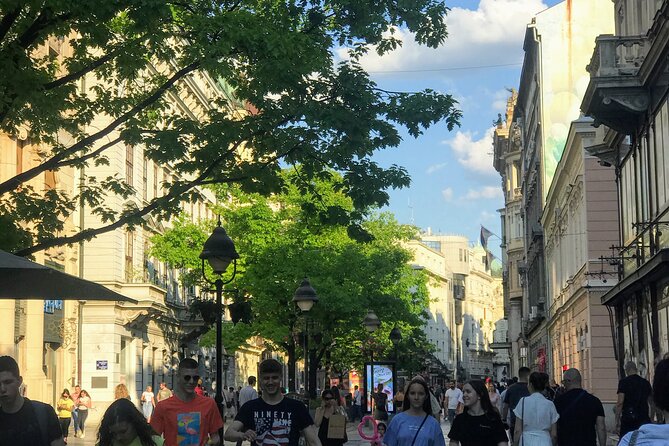
Hotel Moskva brings the history down to street level. You walk along a street once filled with craft workshops and now associated with designers, then enter the hotel for coffee and a look at its luxurious interiors.
The planned treats are the Moskva and Aurora cakes, made according to recipes described as half a century old. Snacks and alcoholic drinks are not included, so you should be prepared to pay separately for anything you order.
This is one of the most appealing parts of the experience because food gives political history a human scale. Exiles needed places to meet, work, trade, and maintain familiar customs. A hotel café can reveal just as much about a community’s daily life as a government building.
You may also get a glimpse of Belgrade’s social scene. The stop is partly historical and partly observational, with the guide pointing out the kind of place where the city’s well-dressed set might gather.
The scheduled time is only about 15 minutes. That means you should not expect a long café visit or a full meal. Think of it as a short pause, a chance to see the hotel’s interiors, and an opportunity to try the two cakes if you choose.
Russian ballet at the National Theatre
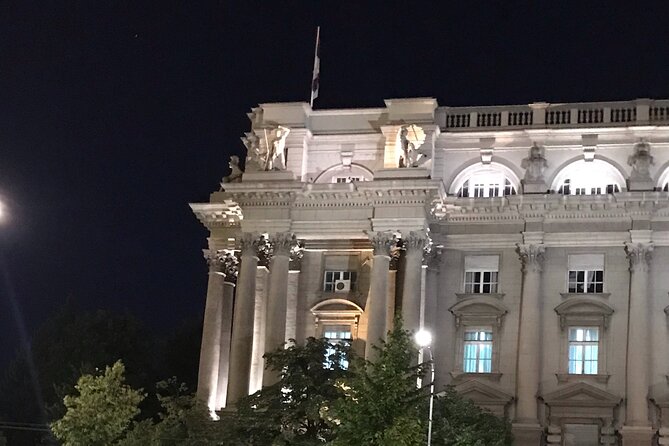
At the National Theatre, the focus turns to performance. Russian ballerinas appeared here, while Russian scenic designers, choreographers, and directors helped shape theatrical life.
This is an important reminder that émigré influence was not limited to government service or military planning. Artists carried professional traditions with them and found ways to work in a new country.
The guide also discusses street songs and Serbian choir culture. One aim is to explain which people deserve kind remembrance when you hear a choir singing in Serbia. That promise suggests a musical and personal angle rather than a narrow account of theatre administration.
You will spend about 15 minutes here. The tour does not include a performance, and no theatre admission is listed. The value comes from standing outside or near the institution while hearing how Russian performers and production staff became part of Belgrade’s cultural life.
If ballet, music, and theatre interest you, this may be one of the strongest stops. If you prefer military history, it gives the route a welcome change of pace but may feel brief.
University life and the fate of émigré scientists
The walk then reaches Belgrade University and the Serbian Academy of Sciences and Arts. The subject is the fate of Russian scientists who left their homeland.
This section asks a practical question: what happens to highly trained people when they lose citizenship, property, professional networks, and legal documents? Some can rebuild careers. Others face barriers even when a host country needs their skills.
That connects directly with the discussion of Nansen passports. These documents were created for stateless refugees who could not easily obtain a passport from a functioning national government. The guide explains why they mattered to Russian émigrés and why people still refer to them in present-day discussions.
You do not need a specialist background to follow this part. The issue is easy to understand in human terms. A person may be educated, experienced, and ready to work, yet unable to cross a border or prove an official nationality.
The stop lasts roughly 30 minutes. It adds substance to the cultural story by showing how migration affected science and education, not only churches and theatres.
Gavrilo Princip Square and the First World War
The final major section includes Gavrilo Princip Square and a discussion of the assassination that helped trigger the First World War. The guide links the event to wider world history and returns to places Russian émigrés visited a century ago.
This is where the tour widens beyond Russian exile. The First World War explains much of the political setting, while the assassination helps you see how an event in the Balkans could produce consequences far beyond the region.
The stop also returns the focus to everyday Belgrade. The route includes places that Russian émigrés used and that remain open today. You are not only hearing about people who passed through the city. You are following the physical parts of their world that can still be seen.
About 30 minutes are allocated here. Since the activity ends back at the meeting point, St. Mark Orthodox Church, you should treat the route as a central-city walking circuit rather than a one-way transfer.
The White Army problem is the tour’s most unusual idea
Many history walks can explain why refugees arrived. Fewer ask what to do with a fully trained and partly armed army that has lost its country.
This tour uses that problem to explore Serbia’s unusual decision. The guide considers how an army in exile could be organized so it would not overthrow the host government, conquer part of the country, or go hungry.
That is a clever way to discuss statecraft. The issue was not simply generosity. Serbia had to think about security, money, discipline, housing, employment, and the danger of importing another country’s civil war.
The subject also gives the tour a balanced tone. The Russian presence left a clear mark on Belgrade, but the guide asks whether that mark was good or bad. You are encouraged to judge the results rather than accept a simple heroic story.
This makes the walk especially suitable for people who like political history, military organization, and questions without tidy answers.
Price, private format, and what you receive
At $173.64 per person, this is expensive for a three-hour activity. There are no listed admission charges, and coffee, cakes, snacks, and alcoholic drinks are not included. You are paying mainly for a private guide, a tightly focused subject, and the ability to ask questions within your own group.
The private format matters. Only your group participates, so Julja can spend more time on the subjects that interest you. If your group is curious about architecture, she can develop that thread. If you care more about the White Army or Nansen passports, you can keep the conversation there.
Group discounts may improve the cost for a larger party. Before booking, compare the per-person price with the size of your group and decide how much you value a private, specialist route over a less focused city walk.
The route lasts around three hours and includes several walking sections. Wear shoes you can use comfortably on city streets. The meeting point is St. Mark Orthodox Church at Bulevar kralja Aleksandra 17, and the activity ends there as well.
Confirmation is provided at booking. Most people can participate, and free cancellation is available if you cancel at least 24 hours before the start time. Later cancellations and changes are not accepted for a refund.
Who should book this Belgrade experience
I would choose this tour if you already know a little about the Russian Revolution and want to see how its consequences reached the Balkans. It also suits anyone interested in refugee policy, royal history, military exile, architecture, ballet, science, or the way food and public spaces preserve memory.
Families can use the private format well, especially if children or teenagers have questions and need the pace adjusted. The route covers several subjects, so it is not limited to one narrow historical interest.
I would be more cautious if you want a standard overview of Belgrade’s main attractions. This is not a general sightseeing tour, and the high price may not feel worthwhile if the White Emigration is only a passing interest.
The strongest reason to book is the guide. Julja is praised for bringing Serbian history to life with emotion, answering detailed questions, and showing the city through the eyes of Russian émigrés. That personal quality matters because the subject can become confusing quickly. A good guide turns separate buildings and names into one connected story.
Final verdict: a specialist walk with real substance
This experience offers an unusual way to understand Belgrade. You move from a Russian church and a military grave to royal monuments, public architecture, a grand hotel, the National Theatre, academic institutions, and a site linked to the First World War.
I like its range and its willingness to ask hard questions. It does not present Russian émigrés only as victims or only as builders of a new life. It looks at their political risks, professional contributions, cultural work, and uncertain legal status.
Book it if you want a private, serious walk led by Julja and you are willing to pay a premium for a specialist subject. Skip it if you want interiors, included food, or a broad first-day introduction to Belgrade. For the right audience, the route offers a thoughtful explanation of how one city absorbed a large and complicated Russian community.
FAQ
How long does the tour last?
The walking experience lasts approximately three hours.
Where does the tour start?
It starts at St. Mark Orthodox Church, Bulevar kralja Aleksandra 17, Belgrade, Serbia.
Where does the tour end?
The activity ends back at the meeting point at St. Mark Orthodox Church.
Is this a private tour?
Yes. Only your group participates in the activity.
Is coffee or food included?
No. Alcoholic beverages and snacks are not included. Coffee and the Moskva and Aurora cakes at Hotel Moskva are available as part of the stop, but you should pay for them separately.
What is the price?
The listed price is $173.64 per person. Group discounts are available.
Can I cancel for a full refund?
Yes, if you cancel at least 24 hours before the experience start time. Cancellations or changes made less than 24 hours in advance are not accepted for a refund.
Just added around Belgrade
- Private Half Day Serbia Tour Novi Sad and Petrovaradin Fortress★ 5.0 · 3 reviews
- 3-Hour Belgrade Zemun Neighborhood Tour★ 5.0 · 8 reviews
- Private Belgrade Street Art and Adventures Walking Tour★ 5.0 · 4 reviews
- Urban & Alternative Belgrade tour★ 5.0 · 4 reviews
- Belgrade Bike Tour: Be a local in the hood of Belgrade!★ 5.0 · 5 reviews
- From Belgrade:Uvac Nature Reserve Tour★ 5.0 · 4 reviews
- Private Wine Tasting by Party in Belgrade★ 5.0 · 3 reviews
- Shooting Experience by Party in Belgrade★ 5.0 · 8 reviews
Belgrade Tours, compared.
Sremski Karlovci and Novi Sad Full-Day Tour from Belgrade
Read our review →
Day Trip from Belgrade: Gems of Eastern Serbia
Read our review →
Belgrade Nightlife Bar Pub Club Crawl with Drinks
Read our review →
Belgrade Big Tour: Top Attractions and Belgrade Neighborhoods
Read our review →
Belgrade Underground Tour w/ Sparkling Wine Along the River
Read our review →
Iron Gate NP Tour with 1-hour speedboat ride + 2 viewpoints
Read our review →Browse the lists this tour appears in